Publications
Publications by categories in reversed chronological order.
* indicates co-primary authors with equal contributions to the work.
2026
-
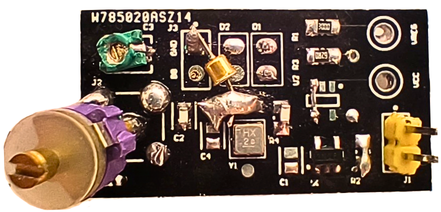 Microwatt Microwave (M²) Oscillator: Going Beyond the Delegation Architecture of Low-power Wireless CommunicationPramuka Sooriya Patabandige*, Dhairya Shah*, C. Rajashekar Reddy, Spanddhana Sara, Prabal Dutta, and Ambuj VarshneyACM MobiSys ’26 Full Paper 🏅 Featured Paper (10/302) 🏅 Best Poster Runner-Up 🏅 ISLPED ’26 Circuit Design Contest: Honorable Mention
@inproceedings{m2_mobisys26, author = {Sooriya Patabandige, Pramuka and Shah, Dhairya and Reddy, C. Rajashekar and Sara, Spanddhana and Dutta, Prabal and Varshney, Ambuj}, title = {Microwatt Microwave (M²) Oscillator: Going Beyond the Delegation Architecture of Low-power Wireless Communication}, year = {2026}, publisher = {Association for Computing Machinery}, address = {New York, NY, USA}, url = {https://doi.org/10.1145/3745756.3809248}, doi = {10.1145/3745756.3809248}, booktitle = {Proceedings of the 24th Annual International Conference on Mobile Systems, Applications and Services (MobiSys '26)}, pages = {941--959}, series = {ACM MobiSys '26} } -
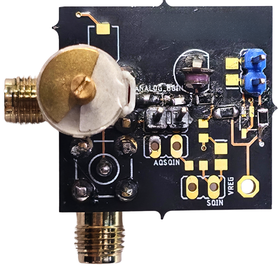 HILO: Enabling Low-power, Dual-Band Communication using Tunnel Diode OscillatorsDhairya Shah*, C. Rajashekar Reddy*, Pramuka Medaranga, and Ambuj VarshneyIEEE RFID ’26 Full Paper
@inproceedings{hilo_rfid26, author = {Shah, Dhairya and Reddy, C. Rajashekar and Medaranga, Pramuka and Varshney, Ambuj}, title = {HILO: Enabling Low-power, Dual-Band Communication using Tunnel Diode Oscillators}, year = {2026}, booktitle = {2026 IEEE International Conference on RFID (RFID)}, series = {IEEE RFID '26} } - Demo: Enabling Low-power Data Streaming through Microwatt Microwave TransceiversDhairya Shah*, Pramuka Sooriya Patabandige*, Rajashekar Reddy Chinthalapani, Spanddhana Sara, Prabal Dutta, and Ambuj VarshneyACM MobiCom ’26 Demo
@inproceedings{m2_mobicom26demo, author = {Shah, Dhairya and Sooriya Patabandige, Pramuka and Chinthalapani, Rajashekar Reddy and Sara, Spanddhana and Dutta, Prabal and Varshney, Ambuj}, title = {Demo: Enabling Low-power Data Streaming through Microwatt Microwave Transceivers}, year = {2026}, isbn = {979-8-4007-2505-0}, publisher = {Association for Computing Machinery}, address = {New York, NY, USA}, url = {https://doi.org/10.1145/3795866.3848446}, doi = {10.1145/3795866.3848446}, booktitle = {The 32nd Annual International Conference on Mobile Computing and Networking}, location = {Austin, TX, USA}, series = {ACM MobiCom '26} } -
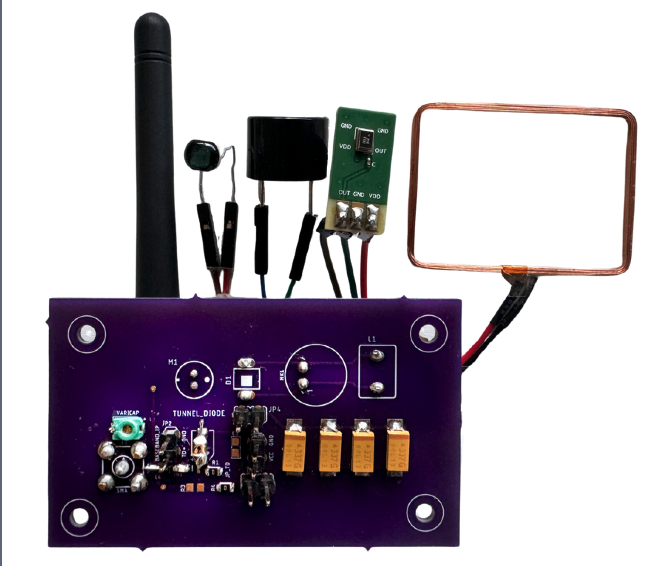 WiP: ZeCoST: Zero-Compute Streaming Sensors using Tunnel DiodesRajashekar Reddy Chinthalapani, Pramuka Sooriya Patabandige, Dhairya Shah, Savitha Viswanadh Kandala, Spanddhana Sara, and Ambuj VarshneyACM MobiCom ’26 Poster
@inproceedings{zecost_mobicom26wip, author = {Chinthalapani, Rajashekar Reddy and Patabandige, Pramuka Sooriya and Shah, Dhairya and Kandala, Savitha Viswanadh and Sara, Spanddhana and Varshney, Ambuj}, title = {{WiP: ZeCoST: Zero-Compute Streaming Sensors using Tunnel Diodes}}, year = {2026}, numpages = {4}, publisher = {ACM}, address = {New York, NY, USA}, url = {https://doi.org/10.1145/3795866.3844791}, doi = {10.1145/3795866.3844791}, booktitle = {Proceedings of the 32nd Annual International Conference on Mobile Computing and Networking}, location = {Austin, TX, USA}, series = {ACM MobiCom '26} } -
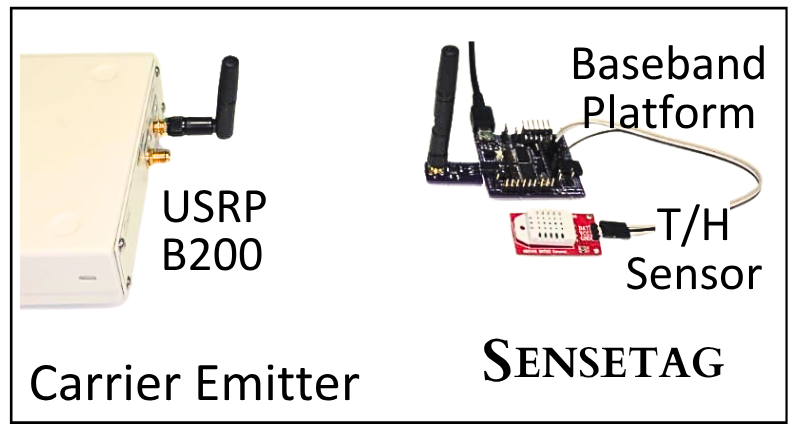 Demo: Ubiquitous Battery-free Sensing AirTagsSpanddhana Sara, Dhairya Shah, Pramuka Sooriya Patabandige, Rajashekar Reddy Chinthalapani, and Ambuj VarshneyACM MobiSys ’26 Demo
Commercial asset tracking systems such as Apple AirTags use hundreds of millions of mobile devices as opportunistic data mules, enabling global location coverage without dedicated cellular infrastructure. However, existing trackers are limited to location reporting, rely on active BLE radios and coin-cell batteries, and cannot support long-term sensing deployments. We demonstrate SenseTag, a work-in-progress tracker that extends AirTag-like functionality towards battery-free, sticker form-factor sensing. SenseTag leverages Apple’s Find My network as a global backhaul for both location and sensor data, using backscatter communication to eliminate the cost of active BLE transmission. A key challenge is implementing Find My’s cryptographic protocol within the tag’s constrained compute and energy budget. Unlike prior systems that encode data into public BLE advertisement fields, exposing it to passive scanners, SenseTag embeds sensor readings into the private-key generation process, preserving Find My-compatible location decryption while preventing exposure to passive BLE scanners. We demonstrate an end-to-end prototype using commodity tag-side hardware and a controllable carrier emitter, backhauling environmental sensor data through Apple’s Find My network and visualizing recovered location and sensor readings on a web-based dashboard.
@inproceedings{sensetag_mobisys26demo, author = {Sara, Spanddhana and Shah, Dhairya and Sooriya Patabandige, Pramuka and Chinthalapani, Rajashekar Reddy and Varshney, Ambuj}, title = {Demo: Ubiquitous Battery-free Sensing AirTags}, year = {2026}, isbn = {9798400727115}, publisher = {Association for Computing Machinery}, address = {New York, NY, USA}, url = {https://doi.org/10.1145/3812835.3814966}, doi = {10.1145/3812835.3814966}, booktitle = {Proceedings of the 24th Annual International Conference on Mobile Systems, Applications and Services Companion}, pages = {159–160}, numpages = {2}, keywords = {backscatter communication, apple find my, opportunistic networks, battery-free sensing, crowd-sourced infrastructure}, location = {University of Cambridge, Cambridge, United Kingdom}, series = {ACM MobiSys '26} } -
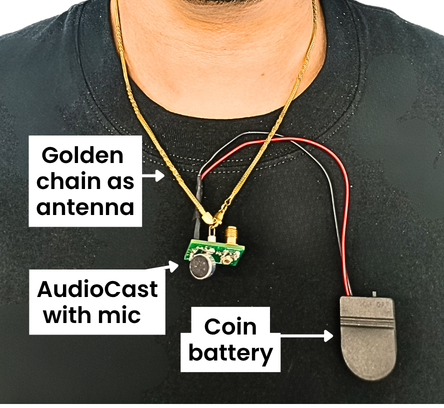 Enabling Low-power Ubiquitous Connectivity for Embedded Systems through Audio-Broadcasting TagsDhairya Shah, Rajashekar Reddy Chinthalapani, and Ambuj VarshneyACM UbiComp ’25 Demo
The challenges in wireless connectivity continue to hinder the widespread, scalable, and sustainable deployment of embedded systems. We introduce AudioCast to address the issues of spectrum scarcity-induced contention and high power consumption of transmitters. It leverages the availability of FM radio receivers operating within the 88–108 MHz spectrum, taking advantage of the superior radio-wave propagation characteristics afforded by lower-frequency bands. Specifically, AudioCast achieves at least a 10x reduction in path loss compared to the 2.4 GHz and 5 GHz ISM bands. This capability enables reliable long-distance communication while minimizing congestion and interference. AudioCast employs a single tunnel diode oscillator to generate carrier signals, which are then self-modulated with data encoded in baseband audio signals. This results in frequency-modulated transmissions that consume under 200 ?W of power, yet travel over 130 m in line-of-sight conditions. Unlike backscatter-based systems, AudioCast does not require an external carrier or depend on ambient signals, introducing a new category of transmitters termed Beyond-Backscatter transmitters, all while maintaining similar low power consumption.
@article{audiocast_ubicomp25demo, author = {Shah, Dhairya and Chinthalapani, Rajashekar Reddy and Varshney, Ambuj}, title = {Enabling Low-power Ubiquitous Connectivity for Embedded Systems through Audio-Broadcasting Tags}, year = {2026}, isbn = {9798400714771}, publisher = {Association for Computing Machinery}, address = {New York, NY, USA}, url = {https://doi.org/10.1145/3714394.3754406}, doi = {10.1145/3714394.3754406}, booktitle = {Companion of the 2025 ACM International Joint Conference on Pervasive and Ubiquitous Computing}, pages = {357–361}, numpages = {5}, keywords = {fm-broadcast spectrum, wireless transmitters, embedded systems, internet of things, tunnel diodes}, location = {Finland}, series = {ACM UbiComp '25} } - Poster: Going Beyond the Delegation Architecture of Low-power Wireless CommunicationDhairya Shah, Pramuka Medaranga, C. Rajashekar Reddy, Spanddhana Sara, Prabal Dutta, and Ambuj VarshneyACM MobiSys ’26 Poster 🏅 Best Poster Runner-Up Award
@inproceedings{m2_mobisys26poster, author = {Shah, Dhairya and Medaranga, Pramuka and Reddy, C. Rajashekar and Sara, Spanddhana and Dutta, Prabal and Varshney, Ambuj}, title = {Poster: Going Beyond the Delegation Architecture of Low-power Wireless Communication}, year = {2026}, publisher = {Association for Computing Machinery}, address = {New York, NY, USA}, url = {https://doi.org/10.1145/3812835.3814882}, doi = {10.1145/3812835.3814882}, booktitle = {Companion of the 24th Annual International Conference on Mobile Systems, Applications and Services (MobiSys '26)}, pages = {66--67}, series = {ACM MobiSys '26} } -
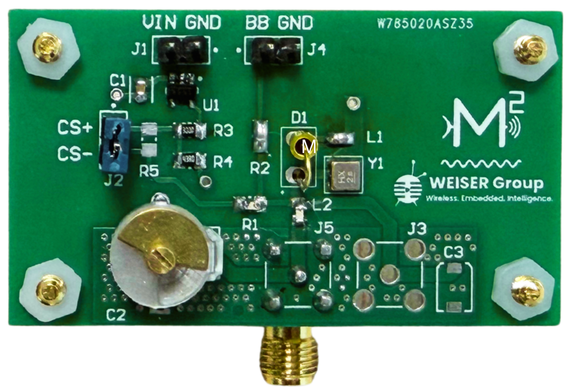 Microwatt Microwave (M²) Oscillator: Enabling 105 μW, Stable and Standalone TransceiversDhairya Shah, Pramuka Sooriya Patabandige, C. Rajashekar Reddy, Spanddhana Sara, Prabal Dutta, and Ambuj VarshneyACM/IEEE ISLPED ’26 Demo 🏅 Low-power Circuit Design Contest: Best Demo Honorable Mention
@inproceedings{m2_islped26demo, author = {Shah, Dhairya and Sooriya Patabandige, Pramuka and Reddy, C. Rajashekar and Sara, Spanddhana and Dutta, Prabal and Varshney, Ambuj}, title = {Microwatt Microwave (M²) Oscillator: Enabling 105 μW, Stable and Standalone Transceivers}, year = {2026}, booktitle = {ACM/IEEE International Symposium on Low Power Electronics and Design (ISLPED '26) Design Demo Contest}, series = {ACM/IEEE ISLPED '26}, doi = {10.1145/3830720.3830731} }
2025
-
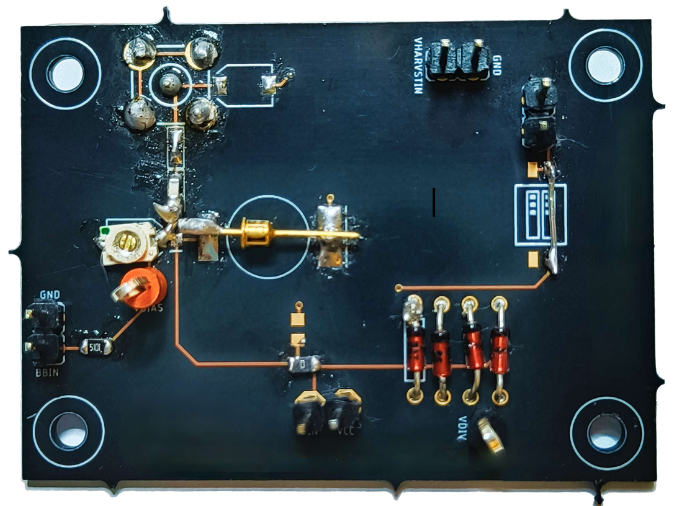 AudioCast: Enabling Ubiquitous Connectivity for Embedded Systems through Audio-broadcasting Low-power TagsC. Rajashekar Reddy*, Dhairya Shah*, Nobel Ang, and Ambuj VarshneyACM IMWUT ’25 Full Paper 🏅 Distinguished Paper Award
Wireless connectivity challenges hinder the deployment of embedded systems. We introduce AudioCast to address two critical issues: spectrum scarcity-induced contention and high power consumption in transmitters. The widespread availability of broadcast radio receivers (for example, FM radios using the 88-108 MHz spectrum) and access to underutilized lower-frequency spectrum motivate the design of AudioCast. The lower-frequency spectrum offers superior radio-wave propagation characteristics, exhibiting at least 10x lower path loss than the 2.4 GHz and 5 GHz Industrial, Scientific, and Medical (ISM) bands while avoiding congestion and interference. These properties enable reliable and long-distance communication, even for weakly radiated signals. AudioCast builds on these properties and the unique negative resistance of a tunnel diode.AudioCast rethinks the architecture of radio transmitters using a tunnel diode oscillator to generate carrier signals and self-modulate them with baseband signals. This results in frequency-modulated transmissions at an overall power consumption below 200 μW. Unlike related systems based on the backscatter mechanism, AudioCast does not require an externally generated carrier or rely on ambient signals. We argue that AudioCast represents an example of a new class of transmitters which we conceptualize as Beyond-Backscatter transmitters. Through experiments, we demonstrate that AudioCast achieves a transmission range of up to 130 m in line-of-sight and tens of meters in non-line-of-sight conditions respectively. These transmissions are decodable by ubiquitous commodity FM receivers in cars, homes, and phones. We evaluate AudioCast through theoretical analysis, benchtop experiments, and urban/indoor field deployments. Additionally, we prototype and demonstrate novel applications, including low-power voice transmissions and hand gesture communication, enabled by AudioCast’s range and power efficiency.
@article{audiocast_imwut25, author = {Reddy, C. Rajashekar and Shah, Dhairya and Ang, Nobel and Varshney, Ambuj}, title = {AudioCast: Enabling Ubiquitous Connectivity for Embedded Systems through Audio-broadcasting Low-power Tags}, year = {2025}, issue_date = {June 2025}, publisher = {Association for Computing Machinery}, address = {New York, NY, USA}, volume = {9}, number = {2}, url = {https://doi.org/10.1145/3729471}, doi = {10.1145/3729471}, journal = {Proc. ACM Interact. Mob. Wearable Ubiquitous Technol.}, series = {ACM IMWUT '25}, month = jun, articleno = {27}, numpages = {32}, keywords = {Beyond-backscatter transmitters, Embedded systems, FM-broadcast spectrum} } - Demo: Enabling Ubiquitous Connectivity for Embedded Systems through Audio-broadcasting Low-power TagsC. Rajashekar Reddy*, Dhairya Shah*, and Ambuj VarshneyACM MobiSys ’25 Demo
@article{audiocast_mobisys25demo, author = {Reddy, C. Rajashekar and Shah, Dhairya and Varshney, Ambuj}, title = {Demo: Enabling Ubiquitous Connectivity for Embedded Systems through Audio-broadcasting Low-power Tags}, year = {2025}, publisher = {Association for Computing Machinery}, address = {New York, NY, USA}, url = {https://doi.org/10.1145/3711875.3734380}, doi = {10.1145/3711875.3734380}, series = {ACM MobiSys '25}, journal = {The 23rd Annual International Conference on Mobile Systems, Applications and Services (MobiSys '25)} } -
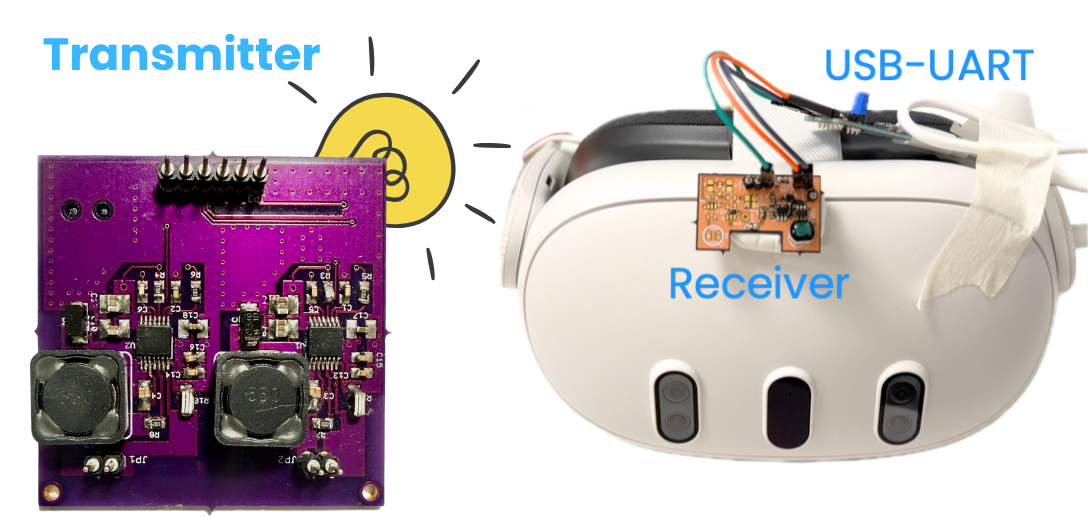 Demo: VisibleBits: Illuminating Mixed Reality with Li-Fi Information SpotlightsCeles Chai Jia Xuan, Dhairya Shah, and Ambuj VarshneyACM MobiCom ’25 Demo
Light Fidelity utilizes light to enable high-bandwidth, low-interference networking and complements traditional radio-frequency links. We demonstrate that Light Fidelity’s precise spatial data confinement makes it a natural fit for mixed reality: By exploiting line-of-sight propagation with mixed-reality headset spatial awareness, we create "information spotlights" - which are localized optical zones that provide context-specific data, such as museum exhibit details or retail product information. This avoids radio frequency based localization, which is both computationally intensive and not supported in today’s commercial headsets. We present VisibleBits, a proof-of-concept Light Fidelity transceiver integrated with a Meta Quest 3 that converts optical signals into a visual serial protocol, overcoming hardware limitations. In our demo, users receive exhibit-specific real-time information, which is then overlaid onto their mixed reality headsets as they enter a Light Fidelity illumination zone.
@inproceedings{visiblebits_mobicom25demo,
  author = {Chai Jia Xuan, Celes and Shah, Dhairya and Varshney, Ambuj},
  title = {Demo: VisibleBits: Illuminating Mixed Reality with Li-Fi Information Spotlights},
  year = {2025},
  isbn = {9798400711299},
  publisher = {Association for Computing Machinery},
  address = {New York, NY, USA},
  url = {https://doi.org/10.1145/3680207.3765607},
  doi = {10.1145/3680207.3765607},
  booktitle = {Proceedings of the 31st Annual International Conference on Mobile Computing and Networking},
  pages = {1251–1253},
  numpages = {3},
  keywords = {light fidelity, information spotlights, mixed reality},
  location = {Kerry Hotel, Hong Kong, Hong Kong, China},
  series = {ACM MobiCom '25}
}
2024
-
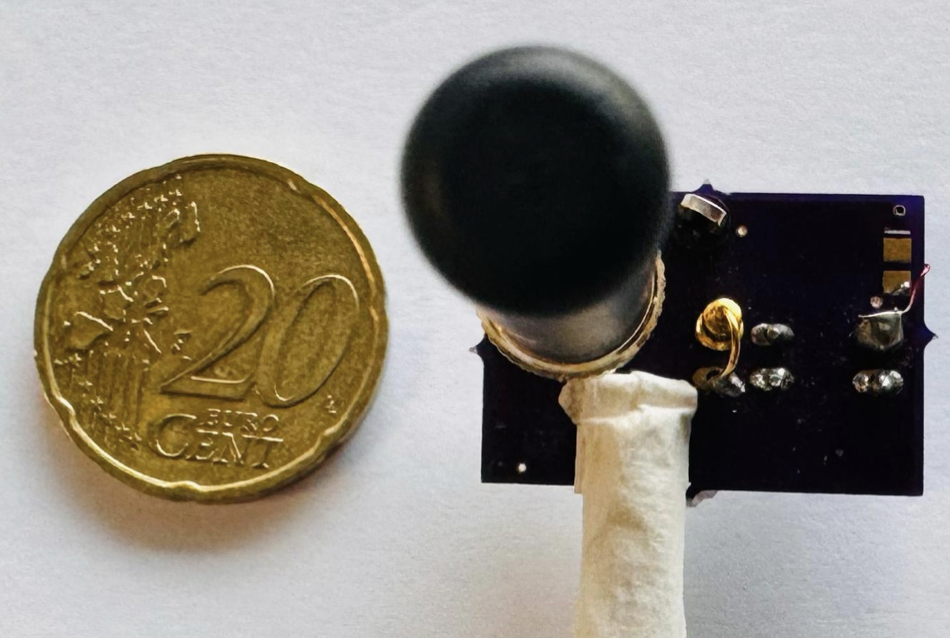 TunnelSense: Low-Power, Non-Contact Sensing Using Tunnel DiodesLim Chang Quan Thaddeus*, C. Rajashekar Reddy*, Yuvraj Singh Bhadauria, Dhairya Shah*, Manoj Gulati, and Ambuj VarshneyIEEE RFID ’24 Full Paper
@inproceedings{tunnelsense_rfid24, author = {Thaddeus, Lim Chang Quan and Reddy, C. Rajashekar and Bhadauria, Yuvraj Singh and Shah, Dhairya and Gulati, Manoj and Varshney, Ambuj}, booktitle = {2024 IEEE International Conference on RFID (RFID)}, title = {TunnelSense: Low-Power, Non-Contact Sensing Using Tunnel Diodes}, series = {IEEE RFID '24}, year = {2024}, volume = {}, number = {}, pages = {154-159}, keywords = {Power demand;Tracking;Resonant frequency;Voltage;Receivers;Transceivers;Sensors}, doi = {10.1109/RFID62091.2024.10582671} } -
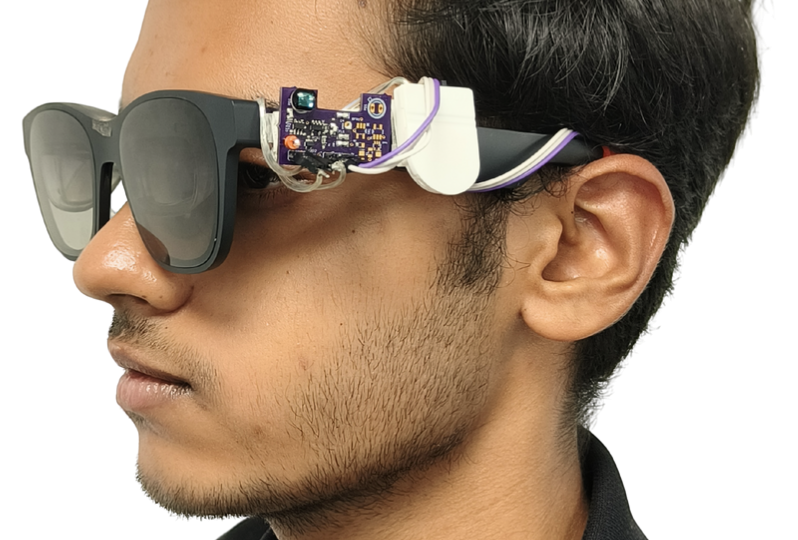 Li-FiAR: Networking Augmented-Reality Devices through Visible LightMoteen Shah*, Dhairya Shah*, Pramuka Medaranga, and Ambuj VarshneyACM S3 (MobiCom) ’24 Workshop
We have seen rapid deployment of augmented reality devices. However, these devices currently suffer from limited battery life. They require frequent recharge, especially when capturing and streaming information wirelessly. In particular, these devices stream information over the radio spectrum using transceivers that are power-hungry, and wireless communication dominates the energy budget of these devices. We present our ongoing work to design a system called Li-FiAR, which proposes integrating Li-Fi with augmented reality devices. Specifically, we implement a transmitter and receiver and integrate them with an augmented reality device. We argue that Li-Fi receivers may consume less power than their radio counterparts while benefiting from the spatial nature of light propagation. This enables novel application scenarios for augmented reality. We demonstrate the transmission of images and audio through Li-Fi, presented on an augmented reality device in this work.
@inproceedings{lifiar_mobicom24, author = {Shah, Moteen and Shah, Dhairya and Medaranga, Pramuka and Varshney, Ambuj}, title = {Li-FiAR: Networking Augmented-Reality Devices through Visible Light}, year = {2024}, isbn = {9798400704895}, publisher = {Association for Computing Machinery}, address = {New York, NY, USA}, url = {https://doi.org/10.1145/3636534.3695899}, doi = {10.1145/3636534.3695899}, booktitle = {Proceedings of the 30th Annual International Conference on Mobile Computing and Networking (MobiCom '24)}, pages = {2230–2232}, numpages = {3}, keywords = {visible light communication, networking, augmented reality}, location = {Washington D.C., DC, USA}, series = {ACM S3 (MobiCom) '24} } -
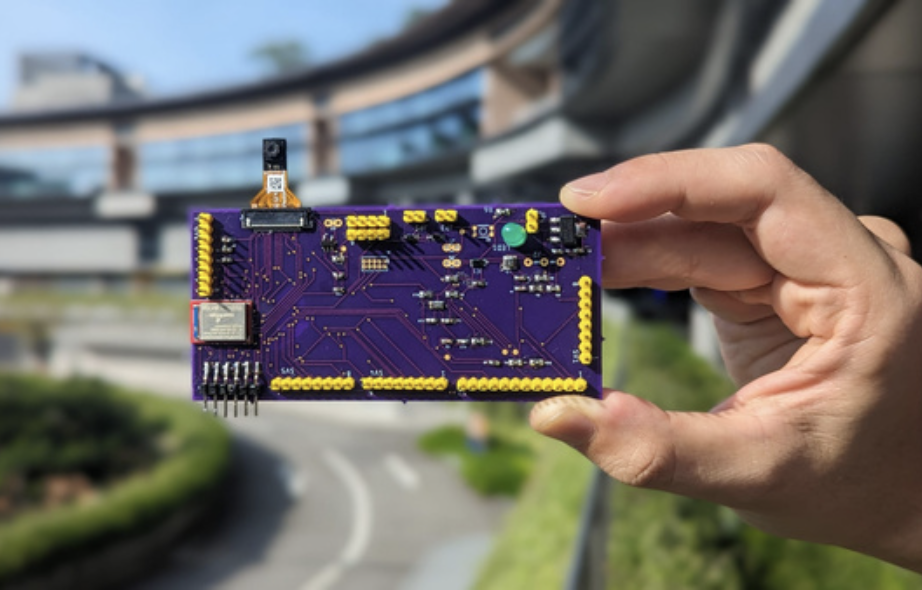 PixelGen: Rethinking Embedded Cameras for Mixed-RealityKunjun Li*, Manoj Gulati*, Dhairya Shah*, Steven Waskito, Shantanu Chakrabarty, and Ambuj VarshneyACM ImmerCom (MobiCom) ’24 Workshop
Mixed-reality headsets offer new ways to perceive our environment. They employ visible spectrum cameras to capture and display the environment on screens in front of the user’s eyes. However, these cameras lead to limitations. Firstly, they capture only a partial view of the environment. They are positioned to capture whatever is in front of the user, thus creating blind spots during complete immersion and failing to detect events outside the restricted field of view. Secondly, they capture only visible light fields, ignoring other fields like acoustics and radio that are also present in the environment. Finally, these power-hungry cameras rapidly deplete the mixed-reality headset’s battery. We introduce PixelGen to rethink embedded cameras for mixed-reality headsets. PixelGen proposes to decouple cameras from the mixed-reality headset and balance resolution and fidelity to minimize the power consumption. It employs low-resolution, monochrome image sensors and environmental sensors to capture the surroundings around the headset. This approach reduces the system’s communication bandwidth and power consumption. A transformer-based language and image model process this information to overcome resolution trade-offs, thus generating a higher-resolution representation of the environment. We present initial experiments that show PixelGen’s viability.
@inproceedings{pixelgen_mobicom24, author = {Li, Kunjun and Gulati, Manoj and Shah, Dhairya and Waskito, Steven and Chakrabarty, Shantanu and Varshney, Ambuj}, title = {PixelGen: Rethinking Embedded Cameras for Mixed-Reality}, year = {2024}, isbn = {9798400704895}, publisher = {Association for Computing Machinery}, address = {New York, NY, USA}, url = {https://doi.org/10.1145/3636534.3696216}, doi = {10.1145/3636534.3696216}, booktitle = {Proceedings of the 30th Annual International Conference on Mobile Computing and Networking (MobiCom '24)}, pages = {2128–2135}, numpages = {8}, keywords = {embedded systems, networking, large language models}, location = {Washington D.C., DC, USA}, series = {ACM ImmerCom (MobiCom) '24} } - Demo Abstract: PixelGen: Rethinking Embedded Camera Systems for Mixed-RealityKunjun Li*, Manoj Gulati*, Dhairya Shah, Steven Waskito, Shantanu Chakrabarty, and Ambuj VarshneyACM/IEEE IPSN ’24 Demo 🏅 Best Demo Runner-Up Award
@inproceedings{pixelgen_ipsn24demo, author = {Li, Kunjun and Gulati, Manoj and Shah, Dhairya and Waskito, Steven and Chakrabarty, Shantanu and Varshney, Ambuj}, booktitle = {2024 23rd ACM/IEEE International Conference on Information Processing in Sensor Networks (IPSN)}, title = {Demo Abstract: PixelGen: Rethinking Embedded Camera Systems for Mixed-Reality}, year = {2024}, volume = {}, number = {}, pages = {271-272}, series = {ACM/IEEE IPSN '24}, keywords = {Headphones;Visualization;Power demand;Magnetic sensors;Mixed reality;Virtual reality;Sensor phenomena and characterization;Embedded Camera Systems;Mixed Reality;Multimodal AI;Low-power Systems}, doi = {10.1109/IPSN61024.2024.00036} } -
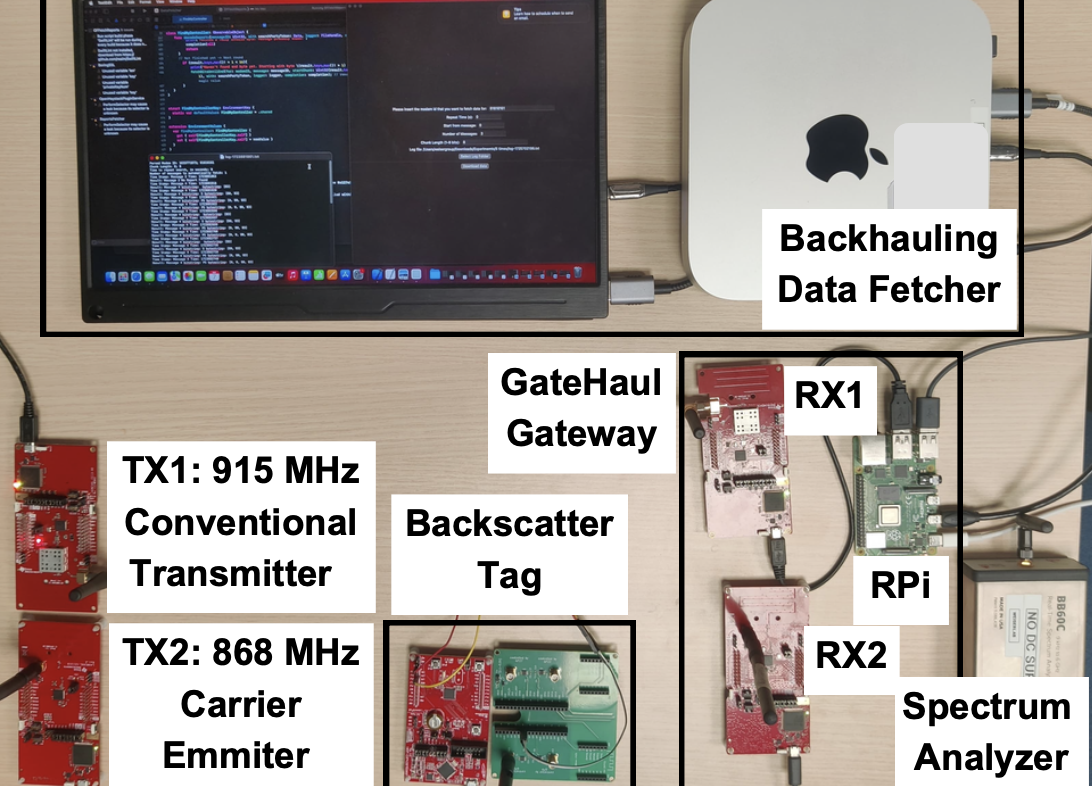 GateHaul: A Gateway Architecture using Backhauling Networks to Address the Connectivity Challenges of Embedded SystemsSpanddhana Sara, Moteen Shah, Dhairya Shah, C. Rajashekar Reddy, and Ambuj VarshneyACM MobiCom ’24 Demo
Significant efforts to address the energy challenges of embedded systems have resulted in the design of new low-power transmitter architectures. These transmitters utilize backscatter or tunnel diode-based mechanisms to enable low-power transmissions by delegating energy-intensive tasks to external infrastructure. However, their widespread adoption is hindered by the need for specialized deployment setups, such as the precise placement of carrier-emitting devices. To overcome this, we are developing GateHaul-a low-cost gateway architecture that provides the required carrier signal, coordinates with other gateways, collects sensor data, and backhauls the information. Notably, GateHaul can backhaul sensor data without conventional networks utilizing emerging opportunistic backhaul networks. We demonstrate an early prototype of GateHaul that collects information from backscatter and conventional devices and backhauls the collected information using Apple’s FindMy network.
@inproceedings{gatehaul_mobicom24demo, author = {Sara, Spanddhana and Shah, Moteen and Shah, Dhairya and Reddy, C. Rajashekar and Varshney, Ambuj}, title = {GateHaul: A Gateway Architecture using Backhauling Networks to Address the Connectivity Challenges of Embedded Systems}, year = {2024}, isbn = {9798400704895}, publisher = {Association for Computing Machinery}, address = {New York, NY, USA}, url = {https://doi.org/10.1145/3636534.3698868}, doi = {10.1145/3636534.3698868}, booktitle = {Proceedings of the 30th Annual International Conference on Mobile Computing and Networking}, pages = {1811–1813}, numpages = {3}, keywords = {gateway, backhaul networks, embedded systems}, location = {Washington D.C., DC, USA}, series = {ACM MobiCom '24} } -
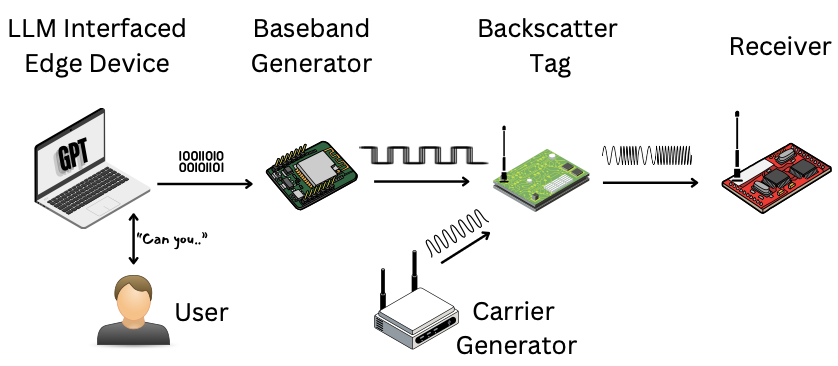 POSTER: Simplifying the Networking of Wireless Embedded Systems using a Large Language ModelPramuka Medaranga*, Dhairya Shah*, Savitha Viswanadh Kandala*, and Ambuj VarshneyACM SIGCOMM ’24 Poster
Wireless embedded systems have seen rapid growth. Nonetheless, the further growth of these systems is now threatened due to the complexities of programming, networking, and deploying them. Developing embedded systems today is a challenging task primarily due to the vast diversity in radio standards, network stacks, microcontrollers, sensors, and other parts of the embedded system ecosystem. This complexity makes it a task suited only for experts, thus hindering the broader adoption of embedded systems.In this early work, we tackle a particular aspect of this challenge related to the complexities of wireless communication. Specifically, we explore the hypothesis that the emergent properties of large language models could help mitigate the complexities of programming the wireless communication stack. We adopt a complex radio transmitter design based on a backscatter mechanism and explore the generation of the transmitter’s logic using state-of-the-art language models. Our exploration leads to insights that, with appropriate prompting, today’s state-of-the-art large language models are already capable of generating complex modulation and backscatter logic. This finding warrants further efforts to design language model generated radio transmitters to simplify embedded systems.
@inproceedings{llm_wireless_sigcomm24poster, author = {Medaranga, Pramuka and Shah, Dhairya and Kandala, Savitha Viswanadh and Varshney, Ambuj}, title = {POSTER: Simplifying the Networking of Wireless Embedded Systems using a Large Language Model}, year = {2024}, isbn = {9798400707179}, publisher = {Association for Computing Machinery}, address = {New York, NY, USA}, url = {https://doi.org/10.1145/3672202.3673752}, doi = {10.1145/3672202.3673752}, booktitle = {Proceedings of the ACM SIGCOMM 2024 Conference: Posters and Demos}, pages = {78–80}, numpages = {3}, keywords = {embedded systems, networking, large language models}, location = {Sydney, NSW, Australia}, series = {ACM SIGCOMM '24} } -
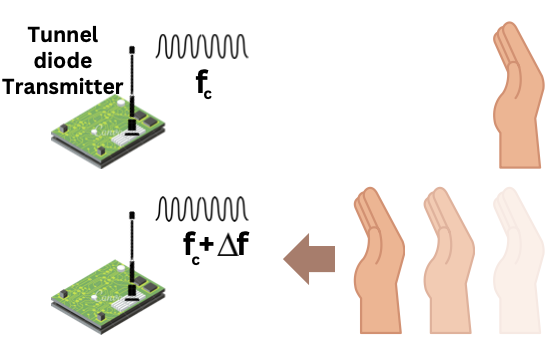 Poster Abstract: Enabling Non-contact, Low-Power Sensing using Tunnel DiodesYuvraj Singh Bhadauria, Lim Chang Quan Thaddeus, C. Rajashekar Reddy, Manoj Gulati, Dhairya Shah, and Ambuj VarshneyACM/IEEE IPSN ’24 Poster
@inproceedings{tunnelsense_ipsn24poster, author = {Bhadauria, Yuvraj Singh and Thaddeus, Lim Chang Quan and Reddy, C. Rajashekar and Gulati, Manoj and Shah, Dhairya and Varshney, Ambuj}, booktitle = {2024 23rd ACM/IEEE International Conference on Information Processing in Sensor Networks (IPSN)}, title = {Poster Abstract: Enabling Non-contact, Low-Power Sensing using Tunnel Diodes}, series = {ACM/IEEE IPSN '24}, year = {2024}, volume = {}, number = {}, pages = {311-312}, keywords = {Radio transceivers;Power demand;Sensitivity;Tracking;Resonant frequency;Information processing;Sensor phenomena and characterization;Low-power Sensing;FM backscatter;FM transmitter;Tunnel Diodes;Radio Frequency}, doi = {10.1109/IPSN61024.2024.00056} }