Low-power transmitters only help if their data can reach the cloud, and specialised gateways are often the most expensive part of a deployment. This line of work uses crowd-sourced networks that already surround us as a free backhaul.
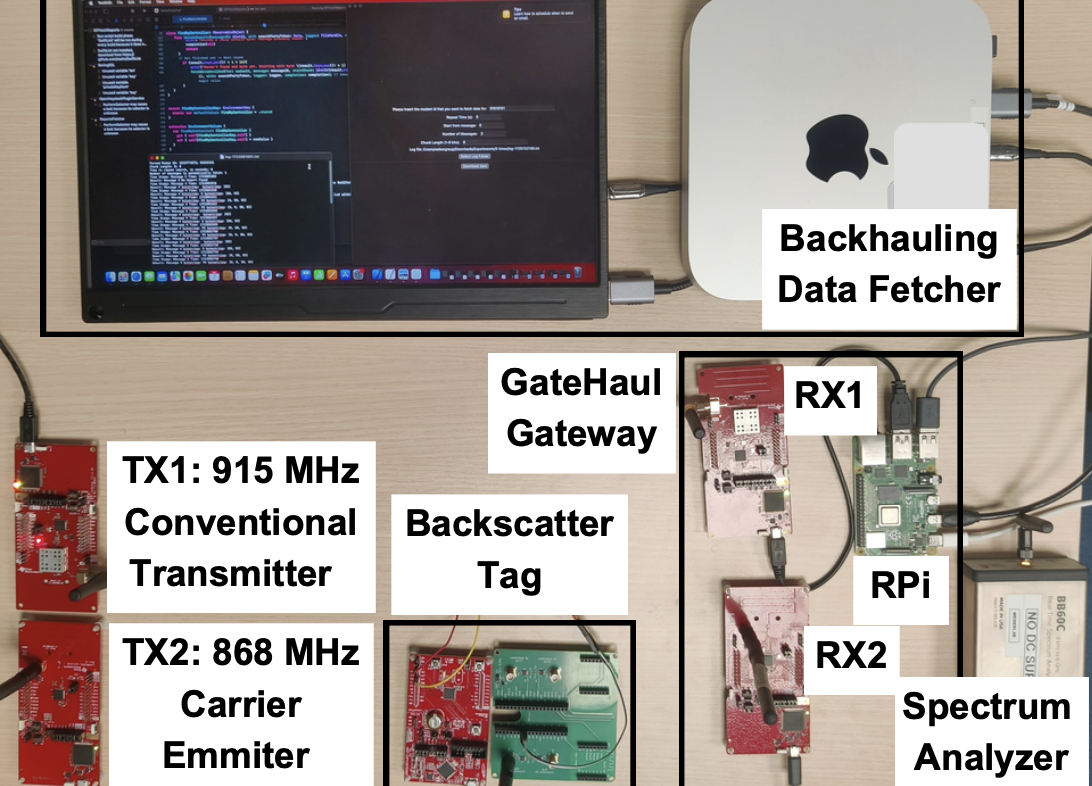
GateHaul (MobiCom ‘24 demo) is a low-cost gateway that supplies the carrier signal backscatter tags need, collects their data, and backhauls it over Apple’s Find My network without any conventional Internet uplink.
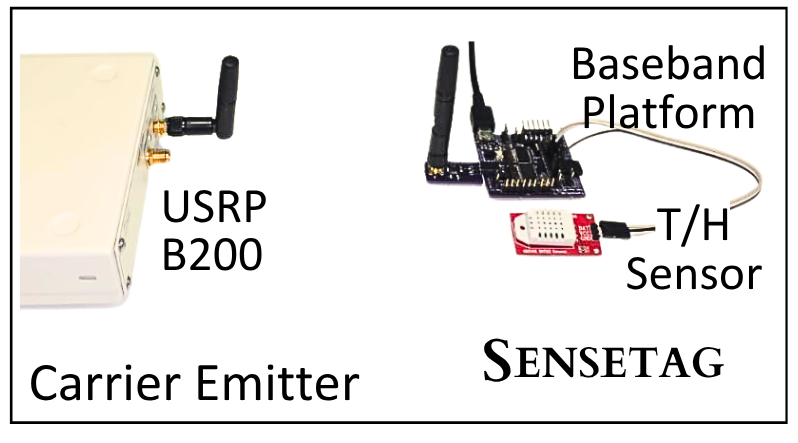
SenseTag (MobiSys ‘26 demo) removes the gateway altogether. It is a sticker-form-factor, battery-free tag that uses backscatter to speak Find My’s protocol, embedding sensor readings into the key-generation process so that both location and sensor data are recovered through Apple’s network while staying hidden from passive BLE scanners.
Commercial asset tracking systems such as Apple AirTags use hundreds of millions of mobile devices as opportunistic data mules, enabling global location coverage without dedicated cellular infrastructure. However, existing trackers are limited to location reporting, rely on active BLE radios and coin-cell batteries, and cannot support long-term sensing deployments. We demonstrate SenseTag, a work-in-progress tracker that extends AirTag-like functionality towards battery-free, sticker form-factor sensing. SenseTag leverages Apple’s Find My network as a global backhaul for both location and sensor data, using backscatter communication to eliminate the cost of active BLE transmission. A key challenge is implementing Find My’s cryptographic protocol within the tag’s constrained compute and energy budget. Unlike prior systems that encode data into public BLE advertisement fields, exposing it to passive scanners, SenseTag embeds sensor readings into the private-key generation process, preserving Find My-compatible location decryption while preventing exposure to passive BLE scanners. We demonstrate an end-to-end prototype using commodity tag-side hardware and a controllable carrier emitter, backhauling environmental sensor data through Apple’s Find My network and visualizing recovered location and sensor readings on a web-based dashboard.
@inproceedings{sensetag_mobisys26demo,author={Sara, Spanddhana and Shah, Dhairya and Sooriya Patabandige, Pramuka and Chinthalapani, Rajashekar Reddy and Varshney, Ambuj},title={Demo: Ubiquitous Battery-free Sensing AirTags},year={2026},isbn={9798400727115},publisher={Association for Computing Machinery},address={New York, NY, USA},url={https://doi.org/10.1145/3812835.3814966},doi={10.1145/3812835.3814966},booktitle={Proceedings of the 24th Annual International Conference on Mobile Systems, Applications and Services Companion},pages={159–160},numpages={2},keywords={backscatter communication, apple find my, opportunistic networks, battery-free sensing, crowd-sourced infrastructure},location={University of Cambridge, Cambridge, United Kingdom},series={ACM MobiSys '26}}
GateHaul: A Gateway Architecture using Backhauling Networks to Address the Connectivity Challenges of Embedded Systems
Spanddhana Sara, Moteen Shah, Dhairya Shah, C. Rajashekar Reddy, and Ambuj Varshney
Significant efforts to address the energy challenges of embedded systems have resulted in the design of new low-power transmitter architectures. These transmitters utilize backscatter or tunnel diode-based mechanisms to enable low-power transmissions by delegating energy-intensive tasks to external infrastructure. However, their widespread adoption is hindered by the need for specialized deployment setups, such as the precise placement of carrier-emitting devices. To overcome this, we are developing GateHaul-a low-cost gateway architecture that provides the required carrier signal, coordinates with other gateways, collects sensor data, and backhauls the information. Notably, GateHaul can backhaul sensor data without conventional networks utilizing emerging opportunistic backhaul networks. We demonstrate an early prototype of GateHaul that collects information from backscatter and conventional devices and backhauls the collected information using Apple’s FindMy network.
@inproceedings{gatehaul_mobicom24demo,author={Sara, Spanddhana and Shah, Moteen and Shah, Dhairya and Reddy, C. Rajashekar and Varshney, Ambuj},title={GateHaul: A Gateway Architecture using Backhauling Networks to Address the Connectivity Challenges of Embedded Systems},year={2024},isbn={9798400704895},publisher={Association for Computing Machinery},address={New York, NY, USA},url={https://doi.org/10.1145/3636534.3698868},doi={10.1145/3636534.3698868},booktitle={Proceedings of the 30th Annual International Conference on Mobile Computing and Networking},pages={1811–1813},numpages={3},keywords={gateway, backhaul networks, embedded systems},location={Washington D.C., DC, USA},series={ACM MobiCom '24}}