Building a wireless embedded system today means juggling radio standards, network stacks, microcontrollers and sensors, a task that is largely reserved for experts. Large language models can write much of that code, but they cannot see whether it actually works on a board.
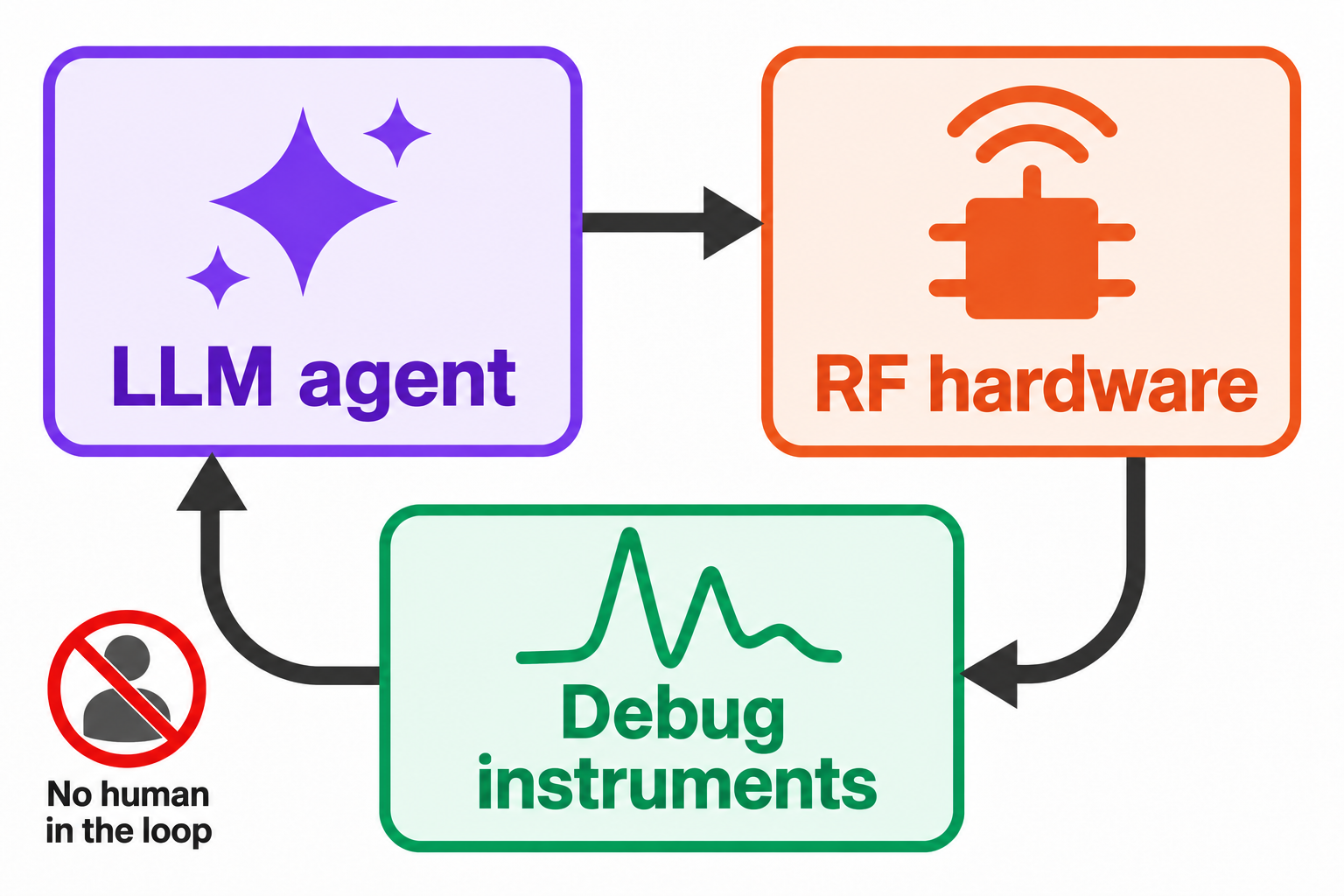
LoopHIL loops hardware into the agent. An LLM-assisted agent generates firmware and radio logic, flashes it to real devices, observes the outcome through instruments and the air interface, and iterates until the system behaves as specified. The preprint is currently under review.
The direction grew out of our SIGCOMM ‘24 poster, which showed that with the right prompting, state-of-the-art language models can already generate complex modulation and backscatter transmitter logic.
Publications
LoopHIL: Looping Hardware into LLM-assisted Agents for Wireless Embedded Systems
Dhairya Shah, Spanddhana Sara, Savitha Viswanadh Kandala, and Ambuj Varshney
@misc{loophil_26,author={Shah, Dhairya and Sara, Spanddhana and Kandala, Savitha Viswanadh and Varshney, Ambuj},title={{LoopHIL}: Looping Hardware into {LLM}-assisted Agents for Wireless Embedded Systems},year={2026},url={https://arxiv.org/abs/2610.24231},series={Under Review}}
POSTER: Simplifying the Networking of Wireless Embedded Systems using a Large Language Model
Pramuka Medaranga*, Dhairya Shah*, Savitha Viswanadh Kandala*, and Ambuj Varshney
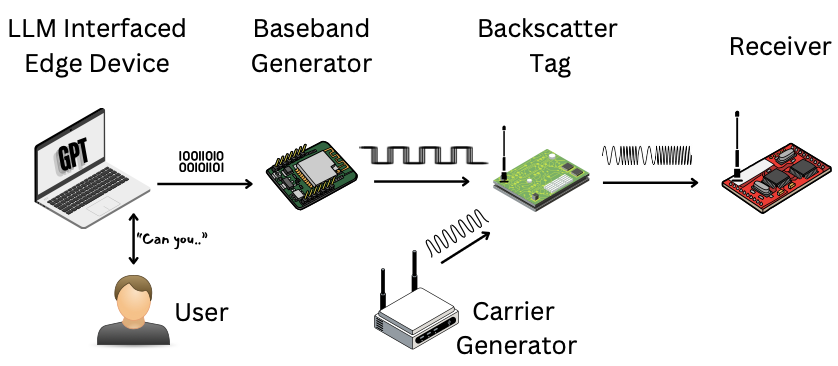
Wireless embedded systems have seen rapid growth. Nonetheless, the further growth of these systems is now threatened due to the complexities of programming, networking, and deploying them. Developing embedded systems today is a challenging task primarily due to the vast diversity in radio standards, network stacks, microcontrollers, sensors, and other parts of the embedded system ecosystem. This complexity makes it a task suited only for experts, thus hindering the broader adoption of embedded systems.In this early work, we tackle a particular aspect of this challenge related to the complexities of wireless communication. Specifically, we explore the hypothesis that the emergent properties of large language models could help mitigate the complexities of programming the wireless communication stack. We adopt a complex radio transmitter design based on a backscatter mechanism and explore the generation of the transmitter’s logic using state-of-the-art language models. Our exploration leads to insights that, with appropriate prompting, today’s state-of-the-art large language models are already capable of generating complex modulation and backscatter logic. This finding warrants further efforts to design language model generated radio transmitters to simplify embedded systems.
@inproceedings{llm_wireless_sigcomm24poster,author={Medaranga, Pramuka and Shah, Dhairya and Kandala, Savitha Viswanadh and Varshney, Ambuj},title={POSTER: Simplifying the Networking of Wireless Embedded Systems using a Large Language Model},year={2024},isbn={9798400707179},publisher={Association for Computing Machinery},address={New York, NY, USA},url={https://doi.org/10.1145/3672202.3673752},doi={10.1145/3672202.3673752},booktitle={Proceedings of the ACM SIGCOMM 2024 Conference: Posters and Demos},pages={78–80},numpages={3},keywords={embedded systems, networking, large language models},location={Sydney, NSW, Australia},series={ACM SIGCOMM '24}}