Wireless communication dominates the energy budget of augmented-reality devices, and radio links offer no natural notion of where the user is. Visible light communication (Li-Fi) addresses both: optical receivers can be lower power than radios, and light’s line-of-sight propagation spatially confines the data.
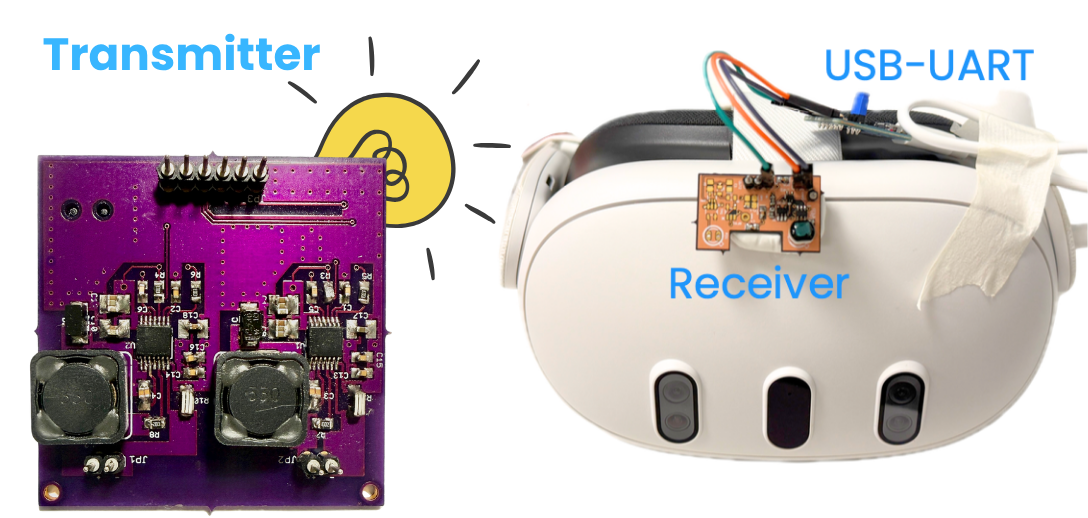
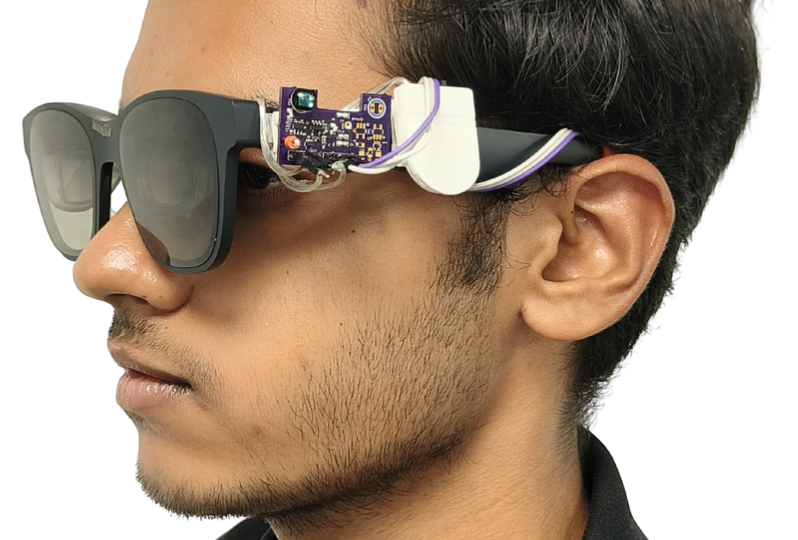
Li-FiAR (S3 workshop, MobiCom ‘24) integrates a Li-Fi transmitter and receiver with an AR device and demonstrates streaming images and audio to the headset over light.
VisibleBits (MobiCom ‘25 demo) builds on this to create information spotlights: localized optical zones that deliver context-specific content, such as museum exhibit details, to a Meta Quest 3 as the user walks into the illuminated area, without radio-based localization.
Publications
Demo: VisibleBits: Illuminating Mixed Reality with Li-Fi Information Spotlights
Celes Chai Jia Xuan, Dhairya Shah, and Ambuj Varshney
Light Fidelity utilizes light to enable high-bandwidth, low-interference networking and complements traditional radio-frequency links. We demonstrate that Light Fidelity’s precise spatial data confinement makes it a natural fit for mixed reality: By exploiting line-of-sight propagation with mixed-reality headset spatial awareness, we create "information spotlights" - which are localized optical zones that provide context-specific data, such as museum exhibit details or retail product information. This avoids radio frequency based localization, which is both computationally intensive and not supported in today’s commercial headsets. We present VisibleBits, a proof-of-concept Light Fidelity transceiver integrated with a Meta Quest 3 that converts optical signals into a visual serial protocol, overcoming hardware limitations. In our demo, users receive exhibit-specific real-time information, which is then overlaid onto their mixed reality headsets as they enter a Light Fidelity illumination zone.
@inproceedings{visiblebits_mobicom25demo,author={Chai Jia Xuan, Celes and Shah, Dhairya and Varshney, Ambuj},title={Demo: VisibleBits: Illuminating Mixed Reality with Li-Fi Information Spotlights},year={2025},isbn={9798400711299},publisher={Association for Computing Machinery},address={New York, NY, USA},url={https://doi.org/10.1145/3680207.3765607},doi={10.1145/3680207.3765607},booktitle={Proceedings of the 31st Annual International Conference on Mobile Computing and Networking},pages={1251–1253},numpages={3},keywords={light fidelity, information spotlights, mixed reality},location={Kerry Hotel, Hong Kong, Hong Kong, China},series={ACM MobiCom '25}}
Li-FiAR: Networking Augmented-Reality Devices through Visible Light
Moteen Shah*, Dhairya Shah*, Pramuka Medaranga, and Ambuj Varshney
We have seen rapid deployment of augmented reality devices. However, these devices currently suffer from limited battery life. They require frequent recharge, especially when capturing and streaming information wirelessly. In particular, these devices stream information over the radio spectrum using transceivers that are power-hungry, and wireless communication dominates the energy budget of these devices. We present our ongoing work to design a system called Li-FiAR, which proposes integrating Li-Fi with augmented reality devices. Specifically, we implement a transmitter and receiver and integrate them with an augmented reality device. We argue that Li-Fi receivers may consume less power than their radio counterparts while benefiting from the spatial nature of light propagation. This enables novel application scenarios for augmented reality. We demonstrate the transmission of images and audio through Li-Fi, presented on an augmented reality device in this work.
@inproceedings{lifiar_mobicom24,author={Shah, Moteen and Shah, Dhairya and Medaranga, Pramuka and Varshney, Ambuj},title={Li-FiAR: Networking Augmented-Reality Devices through Visible Light},year={2024},isbn={9798400704895},publisher={Association for Computing Machinery},address={New York, NY, USA},url={https://doi.org/10.1145/3636534.3695899},doi={10.1145/3636534.3695899},booktitle={Proceedings of the 30th Annual International Conference on Mobile Computing and Networking (MobiCom '24)},pages={2230–2232},numpages={3},keywords={visible light communication, networking, augmented reality},location={Washington D.C., DC, USA},series={ACM S3 (MobiCom) '24}}